
Cleveland County Court Records After Arrest
The Cleveland County arrest to court path runs through two public record systems. The first is the jail custody record kept by the Cleveland County Sheriff's Office and the Cleveland County Detention Center. That record can show whether the person is in custody, the arrest date, the held-for agency, a cell block, release date, and any published hold reasons. It is useful for current custody, but it is not the final criminal case file. The court record begins when District 21 prosecutors file a complaint, information, or indictment in Cleveland County District Court.
That split matters after a Norman, Moore, Noble, Lexington, Oklahoma Highway Patrol, or other local arrest. The jail roster may list a booking charge while paperwork is still moving. The District Attorney may later file a different count, reduce a count, add a charge, or decline a charge. For booking and custody details, use Cleveland County jail inmate records. For booking photos, use Cleveland County jail mugshots. For filed charges, court dates, bond orders, and disposition, search court records through OSCN, ODCR, or the Court Clerk.
Process: Arrest leads to booking, booking leads to first appearance, the District Attorney files charges, and the filed case becomes the court record.
Cleveland County Court Record Search
The official court search named by the Cleveland County Court Clerk is the Oklahoma State Courts Network docket search. The county's records request page tells users to select Cleveland County under the County or Court dropdown when searching dockets. OSCN may ask for a case number, party name, lower court case number, or traffic citation, depending on the search path. During research, automated access reached a turnstile screen, so the field list is based on visible search paths and county instructions rather than live case inspection.
The Cleveland County Sheriff's detention page also links On Demand Court Records, commonly called ODCR, as a court record lookup option. ODCR can be useful when a reader wants a secondary Oklahoma court portal for party and case searches. Neither portal is the jail roster. A case may not appear the same moment a person is booked, especially if the District Attorney has not yet filed formal charges or the Court Clerk has not yet indexed the case.
The OSCN search page captured for the manifest is the court source to start with when looking for a Cleveland County filed case.
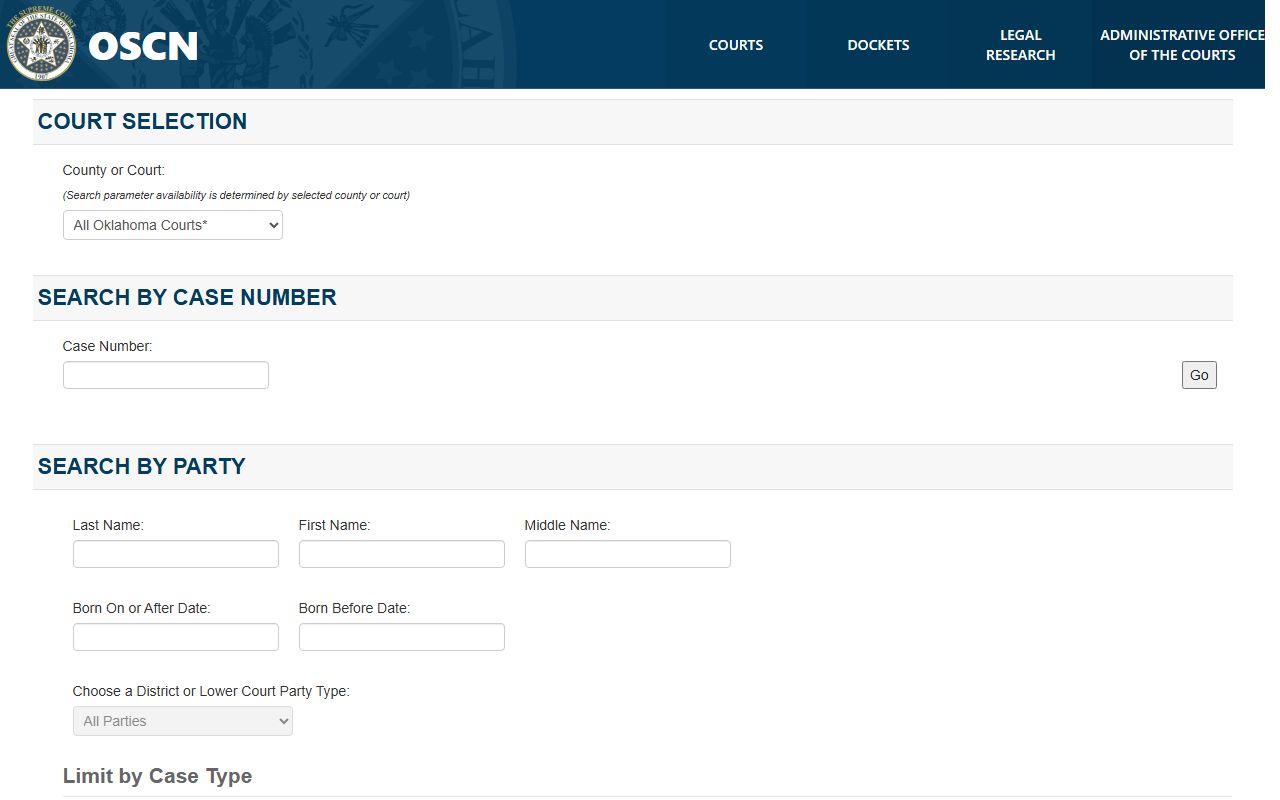
Use the county dropdown and party fields first, then refine with a case number if the jail, attorney, clerk, or DA gives one.
| Search Field | Type | Required | Use After Arrest |
|---|---|---|---|
| County or Court | Dropdown | Yes for local narrowing | Select Cleveland County so statewide results do not bury the local case. |
| Case Number | Text | No | Best when the clerk, DA, attorney, or docket notice gives the exact number. |
| Party Name | Text fields | No | Most common starting point for a defendant name search after booking. |
| Lower Court Case Number | Text | No | Mainly useful for appellate paths, not the first search for a new jail arrest. |
| Traffic Citation | Text | No | Use when the arrest or case began with a District Court traffic citation. |
Find Cleveland County Arrest Court Records
A practical search starts broad and then narrows. A new Cleveland County case can be hard to find if the name is misspelled, the case has not been filed, or the person was booked under a middle name or suffix. Start with the defendant name and Cleveland County, then add a case number or citation number when one appears in a notice, bond paper, attorney file, or court receipt.
- Search OSCN by party name with Cleveland County selected under County or Court.
- Check ODCR if OSCN does not show the case or if the docket is hard to read.
- Compare the court case caption, date filed, and charge list with the booking name and arrest date.
- Read each charge line separately because one case can contain pending, amended, dismissed, and disposed counts.
- Contact the Court Clerk if the docket says a document is available at the clerk's office or if an older file is not online.
Cleveland County says civil, domestic, and criminal cases were computerized in 1989, while probate and confidential cases were added in 1997. Older criminal records may still require clerk help because some records were kept in docket books. For a recent arrest, the common delay is different: the custody record may exist before the formal charge does. That is normal and does not prove that a case was dismissed.
Cleveland County Court Clerk Records
The Cleveland County Court Clerk records, files, and maintains permanent District Court records. The office is led by District Court Clerk Marilyn Williams. The clerk handles court-file access rather than jail custody confirmation, so the request should name the case number if known, the defendant, the document sought, and whether a certified copy is needed.
The Court Clerk records request page gives three request channels. In-person requests go to the Court Clerk's Office on the first floor of the Cleveland County Courthouse, entry through the west door of the courthouse complex. Mail requests go to Cleveland County Court Clerk, 200 S. Peters Ave., Norman, OK 73069. Email requests go to MARILYN.WILLIAMS@OSCN.NET. Mail and email requesters are contacted with the amount due before the request is filled.
The Court Clerk request page is the local source for copy fees, payment steps, and the turnaround rule.
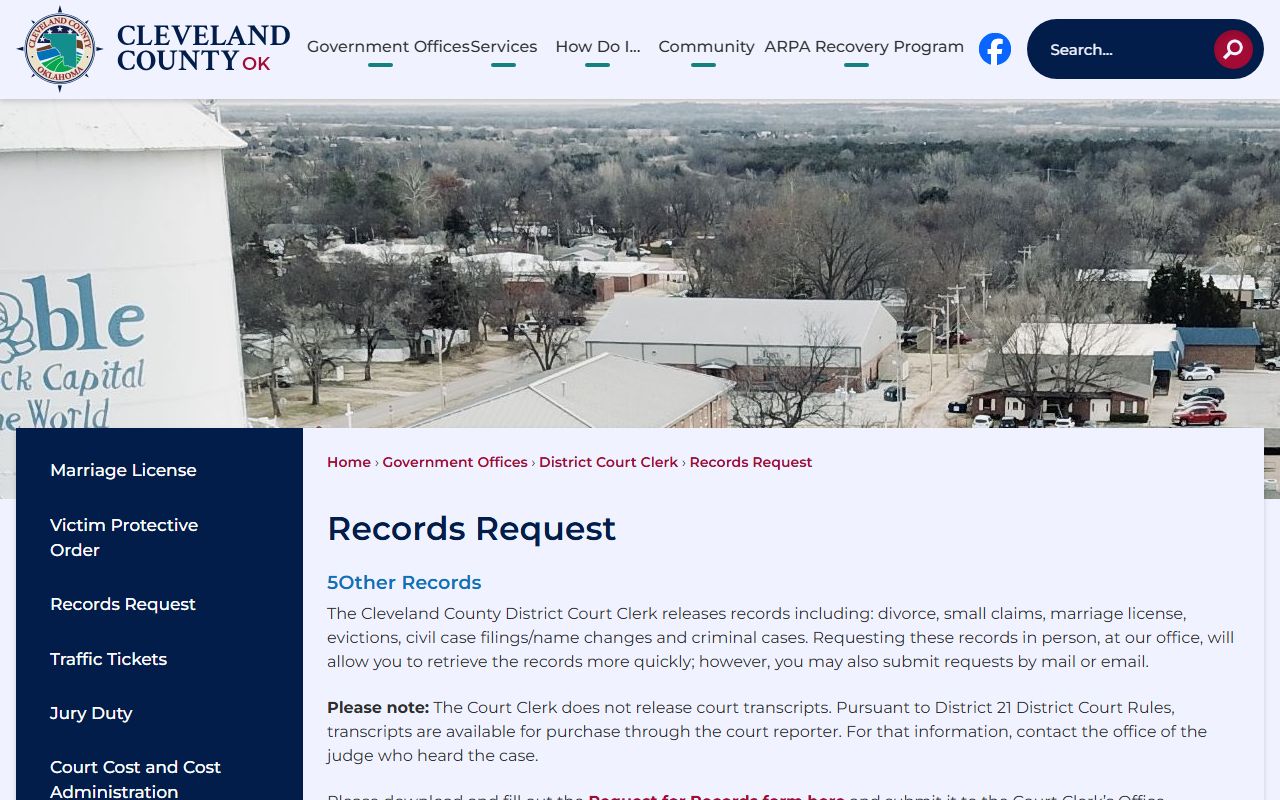
Use the request process when the docket points to a document at the clerk's office, when a certified copy is needed, or when an older record is not easy to find online.
| Item | Fee or Rule |
|---|---|
| First page copy | $1.00 |
| Each additional page | $0.50 |
| Certification per document | $0.50 |
| Certified marriage license | $2.00 |
| Authentication certificate | $5.00 |
| Turnaround | Completed within 10 business days after payment is received. |
Payment may be made by check, money order, or credit card in person. Documents marked on the docket as available at the Court Clerk's Office can be emailed free on request, but certified copies cannot be emailed. Bulk requests may carry a fee. Note: A clerk copy proves what the court file contains, not whether the person is still housed in jail.
Cleveland County Court Charging Documents
After a jail arrest, the charge record starts with a formal charging document. The booking entry is often based on the arresting agency's paperwork. The court file is based on what the District Attorney chooses to file. Oklahoma criminal procedure generally uses an indictment or information for public offenses except certain categories, and local cases may also involve a complaint at an early stage. The plain point is simple: the prosecutor's filing controls the District Court case.
| Document | Who Files It | What It Does | Reader Check |
|---|---|---|---|
| Complaint | Officer or prosecutor | States the accusation and supporting basis at an early court stage. | Compare it with booking language because wording may be preliminary. |
| Information | District Attorney | Sets out the formal prosecutor-filed charge in many Oklahoma criminal cases. | Use it as the main filed-charge source when it appears in the docket. |
| Indictment | Grand jury | Charges an offense through a grand jury process. | Less routine for ordinary county jail arrests, but still a formal charging document. |
District 21 District Attorney Jennifer Austin files Cleveland County state felony and misdemeanor charges. District 21 covers Cleveland, Garvin, and McClain Counties. The Oklahoma District Attorneys Council lists the Cleveland County DA office at the courthouse, 201 S. Jones, Suite 300, Norman, OK 73069, with phone 405-321-8268 and fax 405-360-7840. Governor Stitt appointed Jennifer Pointer Austin as District Attorney for District 21 on December 19, 2024.
Cleveland County Charge Status Records
Charge status is one of the main reasons to use court records after a jail arrest instead of relying only on the jail roster. A person may be booked on one phrase, then charged under a different count. The court docket can show whether a charge is still pending, amended, reduced, dismissed, or resolved by plea or trial. Read each count. One defendant can have several charges in the same case, and the status of one count may not match the others.
| Status | What It Means | Why It Matters |
|---|---|---|
| Pending | The charge is open and has not reached a final disposition. | Court dates, bond terms, and warrants can still change. |
| Amended | The prosecutor changed the filed charge or wording. | The amended count may replace the arrest or booking wording. |
| Reduced | The charge level or offense was lowered. | Bond, plea terms, and sentencing range may shift. |
| Dismissed | The court ended that count without a conviction on it. | A dismissal is not the same as the arrest record disappearing. |
| Nolle prosequi | The prosecutor declined to continue that charge. | The docket should be checked for the exact count and date. |
| Disposed | The count reached an outcome such as plea, trial, deferred sentence, or dismissal. | The disposition controls how the case should be read later. |
Cleveland County Court Bond Records
Bond status can sit in both systems. The jail roster may show a custody release field or hold reason, while OSCN or ODCR may show the judge's bond order, next hearing, and later changes. Oklahoma uses cash, surety, property, personal-recognizance, and no-bond or hold outcomes. Cleveland County detention pages do not publish a full bond posting fee schedule or payment-method list in the inspected materials, so bond posting should be confirmed with the detention center at 405-701-7700 before money is brought or a bondsman is sent.
A dollar amount is not always enough for release. A warrant hold, DOC or parole hold, ICE detainer, out-of-county hold, or no-bond order can keep a person in custody even if one Cleveland County charge has a bond amount. The roster's hold reasons field is useful for that first check, but the court docket controls the pending case. A surety bond should use an Oklahoma-licensed bondsman, and the defendant's exact booking name and date of birth should be checked before posting.
| Bond or Hold | How It Works |
|---|---|
| Cash bond | Paid in full, with local payment method confirmed through the jail or court. |
| Surety bond | Posted through a bondsman for a premium, a common Oklahoma option. |
| Personal recognizance | Release without upfront cash, subject to court conditions. |
| Property bond | Secured by property and handled under court-specific rules. |
| No bond or hold | Release is blocked until the order, detainer, or outside warrant is resolved. |
Cleveland County Sheriff's quick links include warrant-check paths, but research found the older Zuercher portal in maintenance mode and a Global Software warrant request blocked by a web application firewall. Search OSCN or ODCR for case-based bench warrants, and contact the sheriff or court for current warrant status. People with active warrants should speak with an attorney before appearing in person.
Court Arrest Records Compared
A filed charge is not a conviction. This is the key limit in reading Cleveland County court records after an arrest. A charge states what the prosecutor alleges. A conviction requires a guilty plea, no-contest plea accepted by the court, or a trial verdict. A deferred sentence can also appear in the disposition history, and Oklahoma expungement rules treat some deferred outcomes differently from full arrest expungement.
| Point | Charge | Conviction |
|---|---|---|
| Meaning | An accusation filed in court. | A final finding or plea outcome on a count. |
| Timing | Appears near the start or during amendment of a case. | Appears after plea, trial, or final disposition. |
| Proof level | Based on probable cause and prosecutor review. | Requires proof beyond a reasonable doubt or a valid plea. |
| Record use | Shows what was alleged and pending. | Shows what was legally resolved as guilt or a qualifying disposition. |
Sealing and expungement also differ. The OSBI expungement information explains that a Section 18 expungement can expunge an entire arrest record for eligible people. A 991(c) deferred-sentence expungement changes the deferred-sentence disposition, but OSBI says it does not remove the arrest record. Eligibility depends on the case outcome and Oklahoma law.
| Point | Sealed | Expunged |
|---|---|---|
| Public view | Hidden or restricted from ordinary public access. | Removed or treated as no longer public under the applicable order. |
| Oklahoma example | Confidential or restricted case material may not display online. | Section 18 may reach the arrest record when statutory conditions are met. |
| Deferred sentence | The court may update the disposition record. | OSBI notes 991(c) does not remove the arrest record itself. |
| Next step | Read the exact court order. | Consult OSBI guidance and the court file before assuming public removal. |
Cleveland County Court Access Records
Oklahoma's Open Records Act gives the public a right to inspect and copy public records unless another law makes them confidential. Section 51 O.S. 24A.5 covers open and confidential public-body records, while 51 O.S. 24A.8 addresses law-enforcement records, including certain arrestee descriptions and facts concerning an arrest if the agency keeps them. Those laws help explain why jail booking facts may be public, but they do not make every detail public in every case.
Juvenile matters, sealed cases, expunged records, victim information, medical information, and active investigative material may be withheld or redacted. Court records may also be limited when a docket references documents that must be requested from the clerk rather than downloaded. Jail standards and custody reporting laws, including 74 O.S. 192, govern detention operations, but court-file access still runs through OSCN, ODCR, and the Court Clerk.
Important: Do not use casual docket or jail lookups for credit, employment, insurance, tenant screening, or other FCRA-covered decisions.